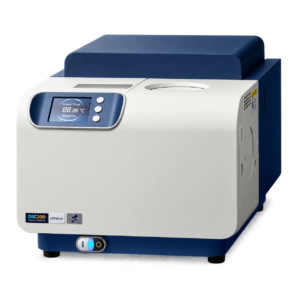
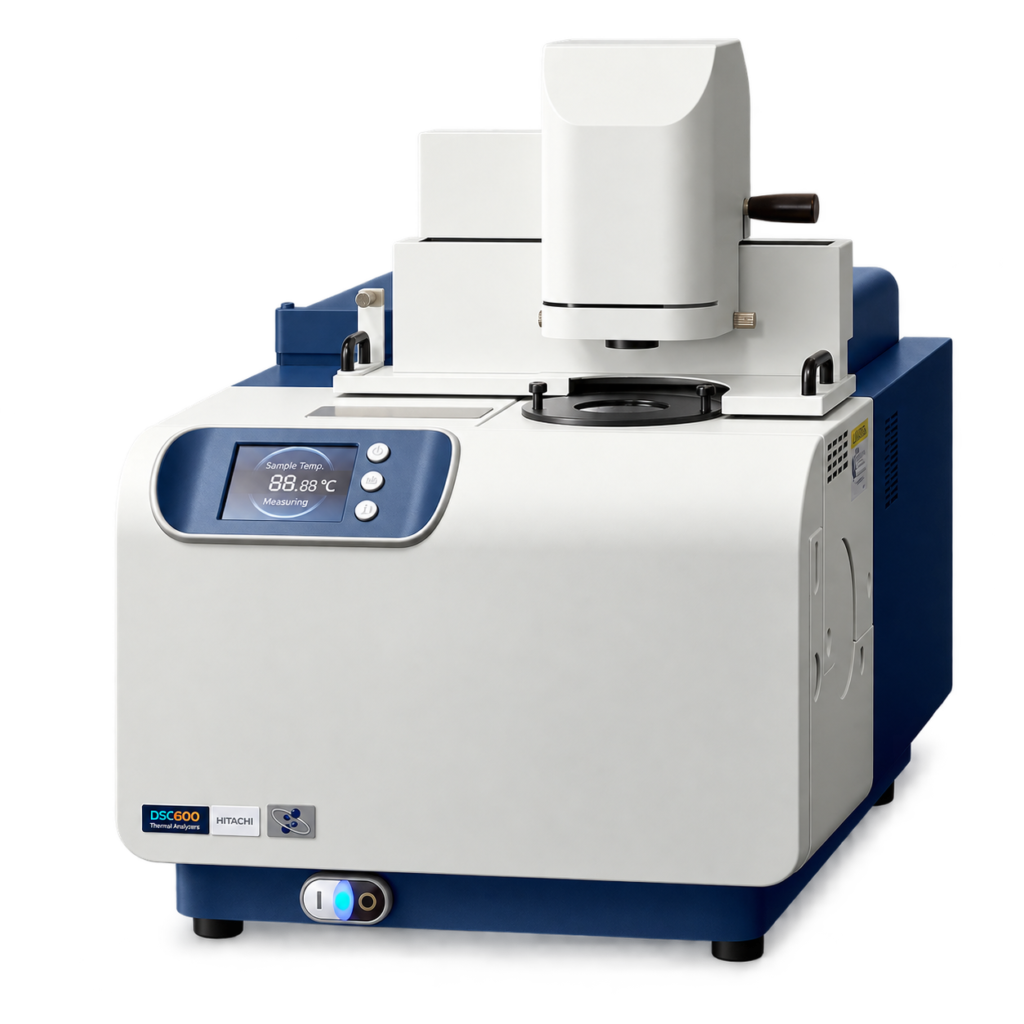
A differential scanning calorimeter (DSC) with top-tier sensitivity and baseline stability, in two versions — DSC600 for advanced materials development and DSC200 for routine quality control.
| Measurement principle | Heat Flux (both versions) |
|---|---|
| Temperature range | -150°C to 725°C (both versions) |
| DSC dynamic range | ±100 mW |
| Sensitivity (RMS noise) | 0,05/0,1 µW |
| Calorimetric accuracy | ±0,05% (calculated from the standard deviation of 10 consecutive indium measurements) |
| Baseline stability | ±5 µW (with Electrical Cooling Unit, -50 to 300°C, 10°C/min) |
| Time constant (resolution) | <3,0 s / <1,1 s with the enhanced peak function |
| Programmable heating rate | 0,01 to 100°C/min |
| Gas control (MFC) | 2 lines (air and inert gas) |
| Cooling system | Dual cooling as standard (both systems can be connected simultaneously, with no manual switching); options: air, electric (ECU), or liquid nitrogen (LN2) cooling |
| Auto-sampler | Optional, up to 50 samples, four-finger design, 2,8x faster than the previous version; the automatic cover opens only after the instrument has cooled |
| Real View® | Standard range -50°C to 300°C (model RVDS0001, compatible with DSC600/DSC200); optional Real View® Polarized Micro Sample Observation Unit — 20-megapixel camera, 50x digital zoom, polarization technology, operating range RT to 350°C — for analyzing anisotropy, crystal orientation, and layer-by-layer melting in multilayer films. Note: the Polarized unit requires a separate control PC dedicated exclusively to DSC + this option (no other module can be connected to it), and it does not work simultaneously with the auto-sampler. |
| UV Irradiation Unit (PDC-8) | An optional add-on for DSC — real-time detection of photochemical reactions (e.g. UV curing), with analysis of dependence on wavelength and irradiation intensity. Wavelength 240-550 nm (selectable: 254/313/365/405/436 nm), max. irradiation intensity 500 mW/cm² (adjustable 0-100%), operating range RT to 150°C, air/inert gas atmosphere. Intended use: development and quality control of photosetting resins/resists and the production processes that use them. |
| Software | NEXTA TA — a guide for less experienced users (guidance function based on standards, calibration guide), simple/standard operating modes, touchscreen control, display customization (graph colors, saved settings), Mobile Station (remote viewing/control); compliant with JIS/ISO/ASTM or custom methods; TMDSC included as standard on all modules. See also Software for NEXTA → for the optional Data I/O software (barcode, Mass Upload Template). |
| Additional options | Automatic sample pan sealer, Mass Upload Template (CSV import of up to 5,000 ID codes), entry via barcode scanning |
| Safety features | Automatic furnace lid with safety sensor, fans, anti-overheating mechanism |
Source: hitachi-hightech.com/global — NEXTA DSC series (features, DSC600/DSC200 specification table by model) and the NEXTA DSC Brochure (Hitachi High-Tech Analytical Science, 2024).