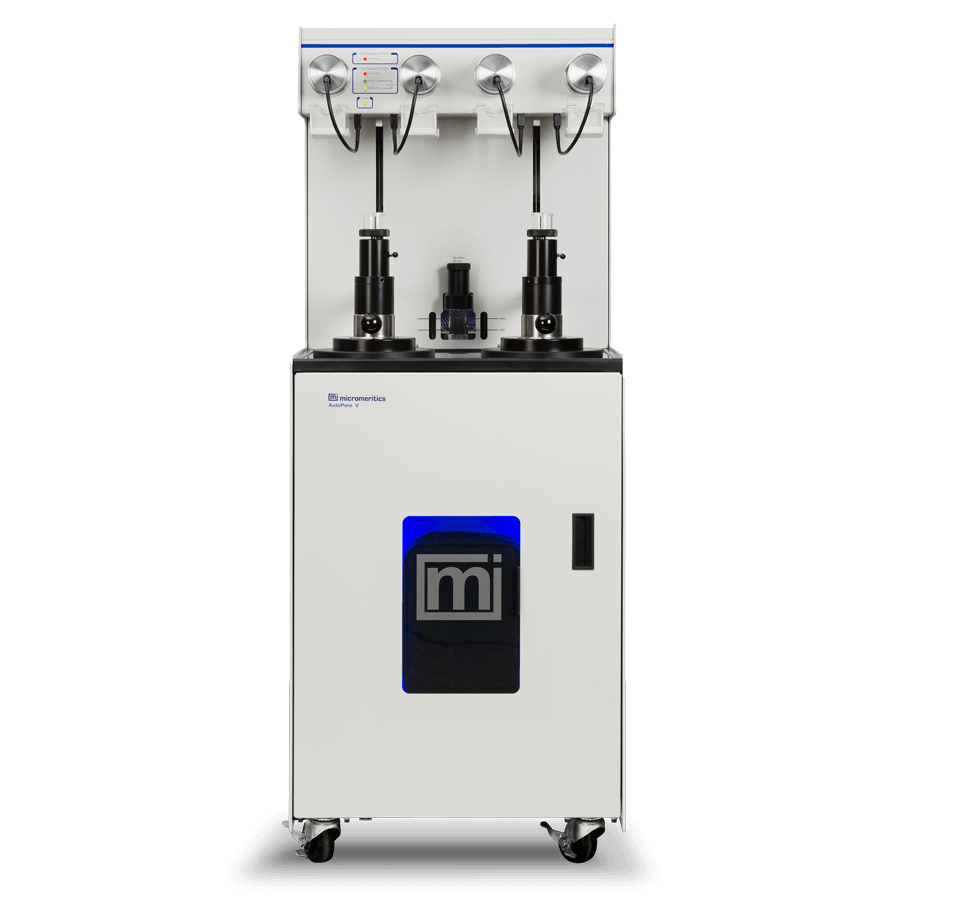
Details
- Results: total pore volume, total pore surface area, median and average pore diameter, pore size distribution, bulk and apparent (skeletal) density
- Scanning and equilibration (time-/rate-of-intrusion) operating modes; quick-scan for fast screening
- MicroActive software – Python scripting for advanced reports, Reverberi method (3D distribution of void and pore-throat size), overlay of up to 20 measurements, and import of pore size distribution from gas adsorption (micro-macro in a single report)
- 19 standard penetrometers (partial list) for various sample sizes/shapes – from powders to rock cores
- Compliant with ASTM D4284, D4404, D6761, ISO 15901-1 and USP <267>
- Typical applications: pharmaceuticals, ceramics, adsorbents, catalysts, aerospace/thermal shields, fuel cells, geoscience, filtration, construction materials, paper, medical implants
| Models / ports |
9600: 2 low + 1 high (up to 33,000 psia) · 9605: 4 low + 2 high (up to 33,000 psia) · 9610: 2 low + 1 high (up to 60,000 psia) · 9620: 4 low + 2 high (up to 60,000 psia) |
| Pressure, low (all models) |
0.2 – 50 psia (345 kPa), steps down to 0.05 psia |
| Pressure, high |
9600/9605: up to 33,000 psia · 9610/9620: up to 60,000 psia |
| Pore diameter range, low pressure |
1100* – 3.6 µm (*with an initial fill pressure of 0.2 psia) |
| Pore diameter range, high pressure |
9600/9605: 6 – 0.005 µm · 9610/9620: 6 – 0.003 µm |
| Intrusion/extrusion resolution |
better than 0.1 µL |
| Dimensions |
H 143 × W 54.3 × D 78 cm · weight 250 kg |
| Power |
100/120/220/240 VAC ±10%, 50/60 Hz, 500 VA |
Source: micromeritics.com/products/autopore-v and the “AutoPore V” brochure (Micromeritics Instrument Corporation, internal archive). Note – source discrepancy: the micromeritics.com/porosimetry landing page describes mercury porosimetry in general terms as a technique with a typical range of “3 nm – 600 µm”, while the specification of the AutoPore V instrument itself (product web page and brochure, both up to date) lists a wider range of 0.003 – 1100 µm on models up to 60,000 psia. The instrument specification was used on this card as the more authoritative source; the general range on the landing page is likely an older/generic description of the technique.